Updated: May 2026
Waerebo Tour — Wae Rebo Tour — UNESCO 2012 Award-Winning Mbaru…
Waerebo Tour is a curated Indonesia luxury tourism experience offered by Wae Rebo Heritage Voyages: handpicked routes, vetted operators, transparent pricing, and 24/7 concierge support across Indonesia.
- What makes Waerebo Tour a premium experience.
- How Wae Rebo Heritage Voyages curates exclusive access and concierge logistics.
- Routes, seasons, and pricing transparency — no hidden fees.
Wae Rebo — the village UNESCO honored.
Eight conical Mbaru Niang houses, 1,200m highland mist, Manggarai people preserving 1,000-year heritage. Recipient of UNESCO Asia-Pacific Heritage Award of Excellence 2012. Respectful 4-day private tour curators.
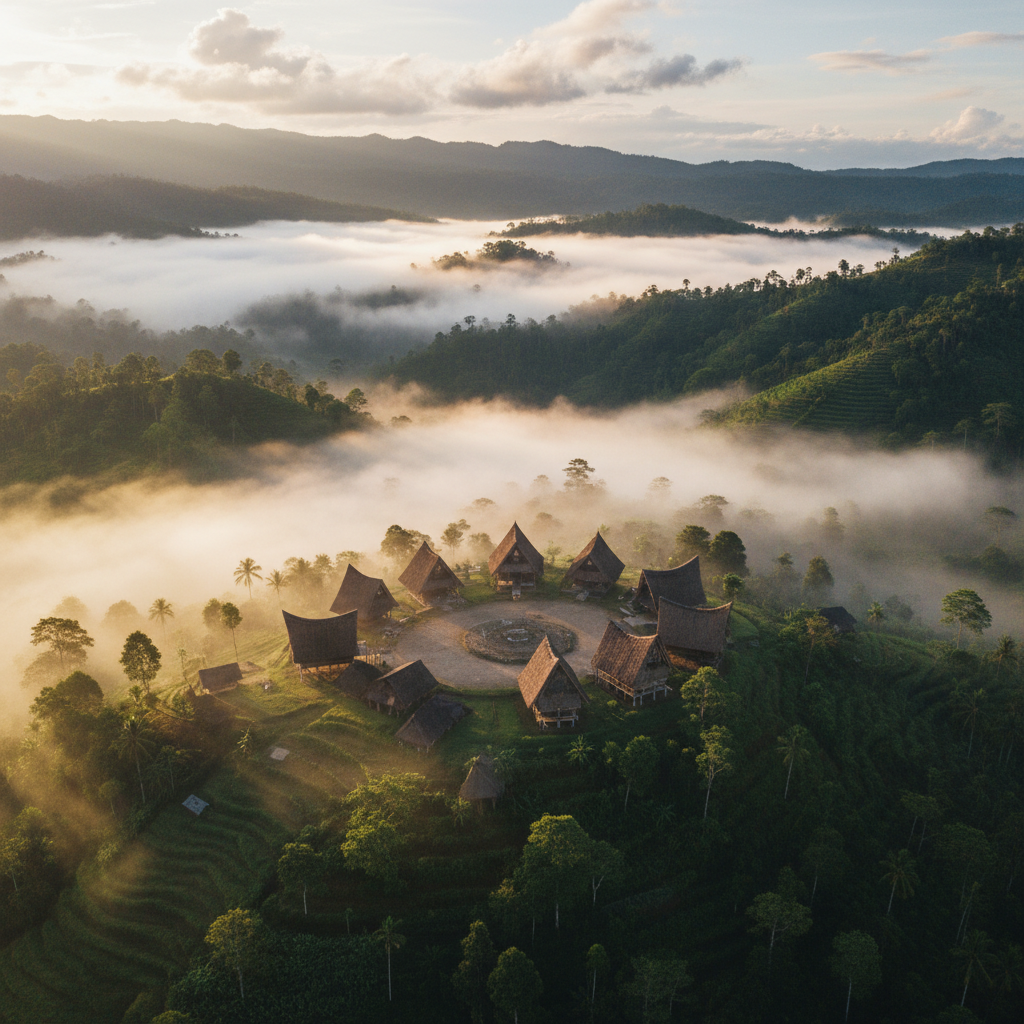 Wae Rebo village morning mist with eight Mbaru Niang conical houses”/>
Why Wae Rebo deserves respect.
UNESCO 2012 honored heritage
UNESCO Asia-Pacific Heritage Award of Excellence — highest tier of cultural conservation. Recognition awarded for the community-led preservation of the Mbaru Niang architecture and Manggarai cultural integrity.
Mbaru Niang architecture
Five-story conical thatched-roof houses, each 15m tall and 12m diameter. Built without nails using traditional Manggarai joinery. Each house holds 6-8 family units. Eight houses make the entire village.
Living, not museum
Wae Rebo is an active community of 1,200 residents. Tourism is welcomed but on the village’s terms. We follow Manggarai custom strictly: arrival ceremonies, cultural orientation, and respectful presence.
Why Wae Rebo is different from typical Indonesian tourism
Wae Rebo is a village 1,200 meters high in the Flores highlands, accessible only by foot — a 3-4 hour trek from the trailhead at Denge. It is not a beach destination. It is not a luxury hotel destination. It is a continuously inhabited indigenous village that the world recognized as architecturally and culturally exceptional. UNESCO awarded it the Asia-Pacific Heritage Award of Excellence in 2012, the highest tier of regional cultural conservation recognition. Visiting Wae Rebo is a privilege the community grants to small numbers of respectful visitors. Tourism is on their terms, not ours.
The Mbaru Niang houses
The eight Mbaru Niang houses are five-story conical structures, each 15 meters tall and 12 meters diameter. Built without nails, using traditional Manggarai joinery passed down through 18 generations. Each level serves a specific purpose: ground floor for living and cooking, second level for sleeping and storage, third for granary, fourth for offerings to ancestors, fifth (the apex) for the most sacred ancestral connections. The architectural integrity is what UNESCO honored — not the photogenic exterior alone, but the continuous functional use across centuries.
The Manggarai people
Manggarai is one of Flores’s three main ethnic groups (alongside Ngada and Lio). Wae Rebo is a Manggarai community of approximately 1,200 residents. They cultivate coffee on terraced highland gardens, raise water buffalo, and maintain a traditional lulik (sacred ancestor protocol) alongside Catholicism (a Portuguese missionary legacy). The Manggarai language is distinct from Indonesian; visiting requires our cultural guide for translation and protocol.
Why our tour respects the village
We bring 4-6 visitors maximum per departure. We arrive following the traditional welcome protocol (offering of betel-nut, formal introduction by village leader). We stay 2 nights minimum (rushed visits are extractive and feel disrespectful). We do not photograph people without explicit permission. We do not interrupt ritual ceremonies. We pay village fees directly to the community fund (managed by village leadership), not to a middleman tour operator. We follow Manggarai dress codes and behavioral expectations.
Who Wae Rebo is for and not for
For: travelers genuinely interested in indigenous architecture, cultural conservation, and slow respectful tourism. Photographers committed to ethical portrait practices. Anthropology and architecture students. Architects studying vernacular building traditions. Travelers willing to trek 3-4 hours and accept basic accommodations (sleeping in homestay-style alongside village families). Not for: package tourists wanting Instagram quick stops. Travelers expecting luxury accommodations. Anyone unwilling to respect cultural protocol.
Why we exist
Wae Rebo’s tourism is small by design. The community supports approximately 200-300 visitor stays per year — divided among multiple small operators. We are one of those operators, focused on extended cultural engagement (4-day programs, 2 nights at the village).
We exist because Wae Rebo deserves a serious tour curator — not a backpacker drop-in. The UNESCO recognition created international interest that the community navigates carefully. We are the tour bridge that respects both the international visitor’s expectations and the village’s continuous cultural integrity.
Plan your Wae Rebo tour
Six visitors max per departure. April-October only.
Practical guide — Wae Rebo (Manggarai, Flores)
Getting there
Komodo Airport (LBJ), Labuan Bajo is the main gateway to Wae Rebo (Manggarai, Flores). Plan to arrive in Labuan Bajo (gateway) and Denge (trailhead) as your base. Most Western travelers connect via Jakarta or Bali; allow a full day for travel given internal Indonesian flight schedules. Direct international connections are limited — almost all visitors transit through Jakarta-Soekarno Hatta (CGK) or Denpasar-Bali (DPS) before continuing to the destination airport.
Best time to visit
April to October (dry season, best for trekking and clear village views). Average temperatures sit at 12-22°C (highland — cooler than coastal Flores), with water temperatures Not relevant — Wae Rebo is highland trekking, not coastal. The off-season runs November to March (rainy, mist-shrouded village, trail conditions difficult). We typically recommend booking 4-6 months ahead for prime-season travel; 2-3 months for shoulder-season departures. Festival calendars and local cultural events shift the optimal weeks each year, and we update our voyage calendar quarterly to reflect the current best windows.
Money, connectivity, and what to bring
Withdraw cash in Labuan Bajo before driving to Denge. Limited ATMs in Manggarai highlands.. Connectivity: 4G in Labuan Bajo; minimal at Denge; no cellular at the village (by design and by terrain). Currency is the Indonesian Rupiah (IDR). Voltage is 220V, plug type C/F. Time zone is WITA (UTC+8), no daylight savings adjustment. Pack light and modular — temperatures vary significantly between coastal and highland sites. Reusable water bottle, sun protection, modest dress for cultural visits, and good walking shoes are minimum requirements. Cash in small denominations works better than cards across most Wae Rebo (Manggarai, Flores) establishments.
Visa and entry
Visa-on-arrival (30 days, $35) for most Western passports. Yellow fever vaccination is not required from US/EU origin countries. Travel insurance is mandatory for our voyages and must include relevant activity coverage (diving for marine destinations, evacuation for highland or remote routes). We provide a recommended insurance broker on request — most clients use World Nomads or DAN (Divers Alert Network).
Safety, language, and tipping
Generally safe. Standard travel precautions apply. Trail conditions vary with weather. Manggarai protocol must be respected. Local language: Indonesian + Manggarai (Manggarai language). Our guides interpret on cultural visits. Tipping: Not mandatory. $15-30/day for guide and porter team appreciated. Village fees paid through tour operator. Indonesian travel etiquette: remove shoes when entering homes, dress modestly at religious sites, and ask before photographing people in villages.
Activity certification level
Not relevant — Wae Rebo is highland trekking and cultural, not diving. We assess each guest individually — the certification is a baseline, not a guarantee. Strong currents, depth, and surface intervals require comfort beyond the minimum certification level. Beginners are welcome on appropriate sites; we will not place guests on dives or treks above their experience level.
Cost expectations
Wae Rebo (Manggarai, Flores) travel costs vary widely. Backpacker independent travel runs $50-90 per day. Mid-range guided tours run $200-400 per day per person. Premium small-group voyages and luxury programs run $500-1,000 per day per person. Total trip cost (including international flights, visas, voyage, insurance, and tips) typically lands at $7,000-13,000 per person for our flagship 7-12 day programs from a US/EU origin.
Why book through us
We are a small operator focused on a tight portfolio of Indonesian destinations. We do not run weekly mass tours. We operate fewer voyages each year, which lets us hand-select naturalists, historians, and divemasters as on-board interpretive guides — most are residents of the regions we visit. Group sizes are intentionally small (eight to twelve guests) so cultural visits remain immersive rather than performative. When we recommend a particular departure window, we are weighing six axes — sea conditions, festival overlap, dive visibility, accommodation availability, school holiday traffic, and historical-site access. Most operators optimize for one or two of these. We optimize for all six. Our pricing is transparent and inclusive — most of what your trip needs is already in the quoted price. We tell you up front what is not included rather than discovering it on day six.
Nearby Indonesian destinations to consider
Wae Rebo (Manggarai, Flores) pairs well with extensions to other Indonesian regions. Bali (Denpasar) is the most common pre-trip stop for jet-lag recovery and gentle introduction to Indonesian travel rhythms. Komodo National Park (Labuan Bajo) suits travelers wanting reef-shark encounters and the iconic Padar Island viewpoint. Raja Ampat in West Papua is the global benchmark for biodiversity and pairs well with Banda for marine-focused trips. Lombok and Gili Trawangan offer beach-relaxation finishes. We coordinate seamless multi-region itineraries on request.